What did a meal taste like 4,000 years ago in ancient Babylonia? Pretty good, according to a team of international scholars who have deciphered and are re-creating what are considered to be the world's oldest-known culinary recipes. The recipes were inscribed on ancient Babylonian cuneiform tablets, and include instructions on how to prepare them, with lots of the recipes containing beer.
The Ain Dara site is located northwest of Aleppo, Syria, and dates back over 3,000 years, to around the 10th century BC. The ancient Syro-Hittite temple was decorated with stone sculptures depicting lions and sphinxes, with massive footprints measuring about one meter long and facing toward the interior of the temple carved into the floor right outside of the entrance.
The states that are called Syro-Hittite were Luwian, Aramaic and Phoenician speaking political entities of the Iron Age in northern Syria and southern Anatolia that arose following the collapse of the Hittite Empire in around 1180 BC and lasted until roughly 700 BC.
The Hittites established an empire centered on Hattusa in north-central Anatolia around 1600 BC. In the Amarna tablets, which have been dated to the 14th century BC, the Hittites were clearly regarded by the Egyptians as a major power. In antiquity, the swastika (卐) was used extensively by the Hittites, sometimes as a geometrical motif, other times as a religious symbol.
Robert Sepehr is an author, producer, and anthropologist.
American congressman Ignatius Loyola Donnelly (1831-1901) wrote a chapter titled "The Aryan Colonies From Atlantis" in his book, Atlantis: The Antediluvian World, where he said:
Did the Aryan race come from Atlantis?
"The center of the Aryan migrations was Armenia. Here too is Mount Ararat, where it is said the ark rested, another identification with the Flood regions, as it represents the usual transfer of the Atlantis legend by an Atlantean people to a high mountain in their new home."
"The Greeks, who are Aryans, traced their descent from the people who were destroyed by the Flood, as did other races clearly Aryan, herein we find another evidence of relationship between the Aryans and the people of Atlantis.. the Greeks, an Aryan race, in their mythological traditions, show the closest relationship to Atlantis. We have seen that Zeus, the king of Atlantis, whose tomb was shown at Crete, was transformed into the Greek god Zeus."
"There is another reason for supposing that the Aryan nations came from Atlantis. We find all Europe occupied by nations recognized as Aryan."
- Ignatius Donnelly, Atlantis: The Antediluvian World, 1882
The Bronze Age is a historical period characterized by the use of bronze, and in some areas proto-writing, and other early features of urban civilization. Aryan is a term that was used as a self-designation by Indo-Iranian people, for example, etched in stone in the Behistun Inscription, a multilingual inscription and large rock relief on a cliff from 522BC at Mount Behistun in modern Iran telling the story of King Darius' conquests.
Phoenicia was an ancient Mediterranean sea-faring civilization that originated in the Levant in the west of the Fertile Crescent. The Silk Road was an ancient network of trade routes that connected the East and West.
Archaeologists in Kazakhstan have recreated the impressive attire of an ancient Scythian princess from fragments discovered in a treasure-filled burial discovered two years ago in the Terekty district of Western Kazakhstan.
They have also placed on display the unique golden artifacts found in the grave of the princess, who has been dubbed ‘Golden Woman’. Dating back 2,500 years, it is the oldest golden burial to have been unearthed in the country.
The 'Golden Woman' was found buried in a mound, known as a kurgan, alongside numerous gold and silver vessels, makeup kits, golden jewelry, a headdress, a horse bridle, and other household items that were considered essential for the afterlife.
The features of her burial are characteristic of Zoroastrianism, an ancient Iranian religion and Aryan philosophy, which spread eastward towards Kazakhstan. The princess belonged to the Saka (ancient Scythians), a group of nomadic warrior tribes of Aryan/Iranian origin, who inhabited the steppes of modern-day Kazakhstan from around 1,000 BC to the first century AD.
In total, more than 500 different golden fragments were found in her burial, which earned the woman her name - the Golden Woman or the Golden Princess. Reconstruction of the garment was entrusted to the famous restorer Krym Altynbekov. Thanks to his work, one can now see what Golden Princess might have looked like 2500 years ago.
She was covered with a blanket embroidered with golden plaques of four types: differently shaped geometric pieces depicted ram griffins, rams, griffins and swastikas. Scientists call them solar, implying worship of the sun characteristic for the nomads of the time, which is also supported by the "Avesta", the core collection of sacred Zoroastrianism texts.
Swastika-shaped plaques depicting four griffin heads arranged in a circular composition.
One artifact that was of particular importance was a wooden comb depicting a battle scene in the war of the Saks against the Persians. The composition shows two soldiers in a chariot and their enemy, a single foot soldier, inscribed in the rectangular space in the center of the crest/comb.
Reconstruction of the comb by Krym Altynbekov
“The Golden Woman/Princess is one of the most astonishing archaeological findings of the recent years,” reports Tengri News. “It sheds some light on the wealth and power of the ancient Scythians.”
LEFT: The pommel of the headdress. RIGHT: Golden bracelets.
British archaeologist Leonard Woolley discovered the tomb of Puabi, which was excavated by his team at the "Royal Cemetery of Ur" between 1922 and 1934.
Puabi's tomb was clearly unique among the other excavations; not only because of the large amount of high quality and well-preserved grave goods, but also because her tomb had been untouched by looters through the millennia.
The forensic examination of her remains, undertaken by London’s Natural History Museum, indicates that she was roughly 40 years old when she died and stood just under five feet tall.
Her name and title are known from the inscription on one of three cylinder seals found on her person. She is most commonly identified by the title "nin" or "eresh", a Sumerian word which can denote a queen or a priestess. Today the common name used is Puabi, which in Akkadian means "Word of my father".
In early Mesopotamia, women, even elite women, were generally described in relation to their husbands. For example, the inscription on the cylinder seal of the wife of the ruler of the city-state of Lagash (to the east of Ur) reads “Bara-namtara, wife of Lugal-anda, ruler of the city-state of Lagash.” The fact that Puabi is identified without the mention of her husband may indicate that she was queen in her own right. If so, she probably reigned prior to the time of the First Dynasty of Ur, whose first ruler is known from the Sumerian King List as Mesannepada.
The cemetary was originally dug outside the walls of the city of Ur, and were built over by the walls of Nebuchadnezzar's larger city about 2,000 years later. Some 1,840 burials were found, dating to around 2600 BC. They ranged from simple burials to elaborate ones in domed tombs reached by descending ramps. Sixteen of the early burials Woolley called 'Royal Graves' because of the rich grave-goods, the presence of burial chambers, and the bodies of the attendants who had apparently been sacrificed.
This photograph gives some idea of the depth to which some of the tombs of Ur were buried.
Most of the spectacular treasures from The Royal Tombs of Ur came from her burial chamber, which hadn't already been looted by grave robbers. Inscribed artifacts from the Seal Impression Strata (SIS) layers above the Royal Tombs at Ur name Mesannepada, King of Kish, an honorific used by rulers claiming control over all of southern Mesopotamia.
Queen Puabi was less than five feet tall, recorded as 4'11", and was clearly a woman of important status, given the wealth and abundance of her grave goods, and the number of men and women who were sacrificed to serve her in the afterlife. She was surrounded with her personal possessions, the richest found in any Sumerian tomb. Buried with her were the bodies of 26 attendants, men and women, and a team of oxen harnessed to a decorated processional chariot.
Female attendants of the Queen found in the Great Death Pit.
Ziggurats ("to build on a raised area") were massive structures erected in the ancient Mesopotamian valley and western Iranian plateau, having the form of a terraced step pyramid of successively receding stories or levels. Ziggurats were built by the Sumerians, Babylonians, Elamites, Akkadians, and Assyrians, each part of a temple complex which included other buildings.
Sun-baked bricks made up the core of the ziggurat with facings of fired bricks on the outside. The facings were often glazed in different colors and may have had astrological significance. Kings sometimes had their names engraved on these glazed bricks. The number of tiers ranged from two to seven; Herodotus describes shrines at the top.
Access to the shrine would have been by a series of ramps on one side of the ziggurat or by a spiral ramp from base to summit. The Mesopotamian ziggurats were not places for public worship or ceremonies. They were believed to be dwelling places for the gods and each city had its own patron god/goddess.
Only priests were permitted on the ziggurat or in the rooms at its base, and it was their responsibility to care for the gods and attend to their needs. The priests were very powerful members of Sumerian society.
An example of a simple ziggurat is the White Temple of Uruk, in ancient Sumer. The ziggurat itself is the base on which the White Temple is set. Its purpose is to get the temple closer to the heavens, and provide access from the ground to it via steps.
The Mesopotamians believed that these pyramid temples connected heaven and earth. In fact, the ziggurat at Babylon was known as Etemenankia or "House of the Platform between Heaven and Earth".
One practical function of the ziggurats was a high place on which the priests could escape rising water that annually inundated lowlands and occasionally flooded for hundreds of miles. Another practical function of the ziggurat was for security. Since the shrine was accessible only by way of three stairways, a small number of guards could prevent non-priests from the shrine on top.
Each ziggurat was part of a temple complex that included a courtyard, storage rooms, bathrooms, and living quarters, around which a city was built. There are 32 known Mesopotamian ziggurats; Four in Iran, and the rest mostly in Iraq.
Image from the movie 300: Rise of an Empire
It has been suggested that the ziggurat was a symbolic representation of the primeval mound upon which the universe was thought to have been created. The temples of the Sumerians were believed to be a cosmic axis, a vertical bond between heaven and earth, and the earth and the underworld, and a horizontal bond between the lands. Built on seven levels the ziggurat represented seven heavens and planes of existence, the seven planets and the seven metals associated with them and their corresponding colors.
There is archeological evidence supporting a direct link between Mesopotamian ziggurats and the pyramids of Egypt.
From Egypt, it crossed the ocean to the pre-Colombian societies of Central and South America, which explains similarities between Mesopotamian ziggurats, Mesoamerican pyramids, and pyramids under or on islands of the Atlantic.
In 1871 Sir Edward Bulwer-Lytton published a novel entitled Vril: The Power
Of The Coming Race about a subterranean civilization able to utilise a
powerful force or earth energy called 'Vril'. This energy could be used for good
or ill, to heal or to destroy (similar to Prana, Chi, Orgone).
The novel was a huge success in its time, and is
credited with giving rise to the Science Fiction Genre. However, it is rarely
read today, Lytton's prose style being incompatible with modern taste.
This can
be seen from an annual competition, run by a Californian University, known as
'The Bulwer-Lytton Fiction Contest'. The one condition of entry is 'to compose
the opening sentence to the worst of all possible novels'.
Joke-worthy
as the book may be now, its influence at the time cannot be downplayed. And it
was Bulwer-Lytton's professed interest in all things occult that led to
speculation that this work of fiction was really based on fact, i.e. that Vril
is a real force or energy.
The Theosophists developed this idea
attracting interest from such notables as Sir George Bernard Shaw. Vril
became the centre of secret societies devoted to its study, the most remarkable
arising in pre second-world-war Germany. The medium Maria Orsic was leader of the 'Vrilerinnen', the beautiful young ladies of the Vril Gesellschaft. Characteristically they all wore their hair in long horsetails, contrary to the popular short bobbed fashion of their day, claiming their long hair acted as cosmic antennas that helped facilitate their contact with beings from other worlds.
According to the legend of the German Vril society, a fateful meeting was held in 1919 at an old hunting lodge near Berchtesgaden, where Maria Orsic presented to a small group assembled from the Thule, Vril and Black Sun Societies, telepathic messages she claimed to have received from an extraterrestrial civilization existing in the distant Aldebaran solar system, sixty-eight light years away, in the Constellation of Taurus. One set of Maria's channeled transmissions was found to be in a secret German Templar script unknown to her.
Researcher Wendelle Stevens tells us that, rather than a militant gesture of aid to aggressive Nazis, the Aldebarans perceived an economic disparity in Earth cultures that fueled perpetual wars and conflict.
To alleviate this disparity the Aldebarans reasoned that by offering 'free-energy' technologies, used to create affordable mass transportation devices, a new innovative generation of industries, promoting prosperity and greater peaceful interaction between nations might result; thus diminishing violent wars.
Clearly such a plan resonated with members of both the Thule and Vril Societies and their dream for a clean and free technology based on this 'alternative science' harnessing Vril energy.
Here is a short summary of messages the Vril medium had received over the years and which formed the basis for all further actions by the Vril-Gesellschaft, compiled by author Jan van Helsing. This material is not science fiction, but represents truly what was going on in the Inner Core of Thule and Vril. It should be emphasized to the reader that even if you don’t believe a word of this, it’s irrelevant. They believed it and they built at least two very complicated secret societies around it - and these societies became quite powerful and influential:
The solar system Aldebaran has a sun around which revolve two inhabited planets that form the empire SUMERAN. The population of the Aldebaran system is divided into the original "pure" race of people (Aryans) and several other human races that had devolved by genetic mutation from the parent population because of climatic changes brought about by nuclear war upon the planets.
The more the races intermixed, the lower the spiritual development of these people collectively sank, which led to the situation that when the sun Aldebaran began expanding they could no longer maintain the space travel technology of their forefathers and could not leave the planets by their own means. The genetically degraded races, totally dependent upon the master race, had to be evacuated and were brought to other inhabitable planets. They colonized our solar system, starting with the planet Mallona (also called Maldek, Marduk or Phaeton among Russians) that existed at that time between Mars and Jupiter, now occupied by the asteroid belt.
Despite their physical and cultural differences, all the races respected one another and did not interfere with each other, neither the so-called genetically "pure" people nor the mutated hybrid races. Each respected that the others just made their own developments [in contrast to what happens on Earth].
Members of the Vril Society believed that Aldeberans landed on Earth following global cataclysms, when the planet became slowly habitable again in the region of Mesopotamia. Re-establishing civilization they formed the dominant ruling nobility of the Sumerians and various other early societies, governing through an elite bloodline and segregated caste system; interracial inter-breeding (mixing blood) was strictly taboo.
The mediums were said to have had also received precise information about the civilizations on the inhabited planets situated around the sun Aldebaran and a 'one way' trip was scheduled to depart towards the Pleiades to re-unite.
Despite their distrust of men, the women of Vril eventually did join with the Thule Gesellschaft and DHvSS in order to construct an inter-dimensional channeled flight disc known as the JenseitsFlugMaschine (JFM).
But unlike the other two groups the Vril Gesellschaft were an inner circle of women who were also fighting against their times and culture.
With substantial financial backing, the odd disc shaped machines were successfully constructed in Munich and secretly tested for several years. Thule wanted to develop both a production combat craft and a functional Raumschiff (Spaceship).
The Vril, by comparison, only wanted to develop Raumschiffe (Spaceship) to reach Aldebaran in the Taurus Constellation 64 light years from earth. Had the Vril maidens retained control of the projects born from the channeled information they received, subsequent events may have been very different.
Unfortunately they got tangled up with the militarized political branch of the Thule and other nationalist occult groups, all bent on revenge against the rest of Europe for the humiliation of defeat of World War I. When the Nazi party came to power in Germany, Maria and the Sisters had no real choice but to go along for the ride.
The Nazis successful development of functioning disc craft during the war is now well documented. Virgil Armstrong, former CIA operative and former Green Beret, said the German flying machines during World War II could land and take off vertically and fly at right angles. They reached 3000 km / h and were armed with cannons which could penetrate a shield 10 cm thick.
In early 1943, the Nazis embarked on the design of a cigar-shaped spaceship that was to be built in the workshops of Zeppelin. It was the ''Andromeda'' Apparatus and was designed to transport several spacecraft in a plate form for interstellar flights.
When they occupied Germany, in early 1945, the British and the Americans discovered, among other things, the secret files of the SS, photos Haunebu II and the Vril 1 as well as the Andromeda. In March 1946, President Truman gave the orders to collect the Nazi material and to classify the technology as Top Secret. German scientists working undercover, were given false papers and sent to the U.S. as part of the framework of "Operation Paperclip".
Meanwhile Maria Orsitsch and the Vril Circle mysteriously disappeared, never to be heard from again, fueling speculation among some writers that Maria may have in fact escaped, as she claimed, to Aldebaran. A recently published "Letter of Departure" to the Young Vrilerinnen (jungen Vrilerinnen), dated March 11, 1945, mentions the "Odin Departure" (Odin-Ausflug). It refers to a temporary evacuation location with Maria, and the final departure to Aldebaran.
The letter ends: “niemand bleibt hier” (no one is staying here) and is signed "With Cheerful Courage" (Mit frischem Mut) by Godrun.
In Norse mythology Gudrun was the sister of Gunnar, both children of Giuki – king of the Nibelungs. Sigrun (another Vril Maiden) was one of the nine daughters of Odin.
Regardless of how much of this story is factual, and how much is modern myth, why is there nothing about this in school textbooks, encyclopedias, or reported in the media?
Particularly in Germany, where there is freedom of the press and they declare that they only teach the truth. Surely it is reasonable to discuss the real truth now, after 70 years, openly without being arrested or publically labeled a "racist".
During the time that I. G. Farben supported Hitler, their partner Standard Oil (Rockefeller) organized the people against the Nazis. Likewise, Ford Motor Company made armaments for the U.S. Army, but produced, while in Germany, military vehicles for the Nazis. Ford and Opel (subsidiary of GM that is controlled by JP Morgan) were the two largest car manufacturers in Germany for Hitler. No matter the winner, globalist multinational corporations were instigating and profiting from all sides.
What's more, in 1946 the Rockefeller foundation paid $139,000 USD for the exclusive rights to the official 'public version' report of the History of the Second World War, which concealed all the help provided by American bankers in financing and arming the Nazi war machine. They also made sure to keep from the public the truth behind Admiral Byrd's mission to Antarctica immediately following WW2, a secret that has lasted as long as the cover-up concerning the events at Roswell.
It was also silent about the mystical and occult ideology behind the Nazi regime, including the Vril inspired free-energy technology, which was rumored to have been later perfected at the infamous Area 51, near the site of the Roswell incident. The major donor was the Rockefeller's Standard Oil.
In 1894 the Indian astronomer, Sri Yukteswar, wrote that the cause of the precession of the equinox was the result of our sun’s orbit around another star. He estimated the orbit period at 24,000 years. This long cycle is the same concept as Plato's Great Year, as well as the Maya Long Count calendar.
The deeper occult (hidden) meaning of the pre-Christian cross, as well as it's 4 cardinal points, are of great importance in esoteric astrology and astro-theology. This understanding is the essence behind the symbol most famously referred to as the "Swastika" in Sanskrit (卐), the symbol and its meaning pre-dates written Sanskrit itself.
Astro-theology is the study of the astronomical influence on religion. The ancient Greeks associated the Swastika with the sun god Apollo, exemplifying the symbol's historic and universal use as a solar emblem.
The Fixed Cross, consisting of the four constellations, has the same four signs regarded in the Christian belief as the four living creatures of the prophet Ezekiel. These four had the face of a man, Aquarius; the body of a lion, Leo; the horns of an ox, Taurus; and the wings of an eagle, Scorpio. The Eagle was astrologically interchangeable with Scorpio.
These same 4 fixed signs of the zodiac are symbolized in the four evangelists, and in the four beasts of Revelations.
When Moses was said to have descended from the mountain with the ten commandments (17th - 13th century BC, the end of the Age of Taurus), some of his people or followers were found by him to be worshipping a golden bull calf. He instructed these worshippers to be killed. This represents Moses "killing" the bull and ending the Age of Taurus, and ushering in the Age of Aries, which he represents when he is sometimes depicted with ram horns.
This is the same scenario when Mithras, as the solar hero/deity, ends the Taurean Age by killing the Bull, ushering in the Aryan age. This ancient ritual is still played out with bullfighting today, and the reason why the bullfighter with the red solar cape (Bulls are color blind) traditionally ends up killing the bull at the end.
"You remember only one deluge, though there have been many...
You and your fellow citizens are descended from the few survivors that remained, but you know nothing about it because so many succeeding generations left no record in writing. The change in the rising and setting of the sun and the other heavenly bodies, how in those times they used to set in the quarter where they now rise, and used to rise where they now set...
Of all the changes which take place in the heavens this reversal is the greatest and most complete ..There is at that time great destruction of animals in general, and only a small part of the human race survives." - Critias by Plato 360 B.C.E
Studies carried out by scientists from the Institute of Forensic Genetics at the University of Copenhagen have concluded that all blue-eyed people share a common ancestor, someone who lived 6,000 to 10,000 years ago near the area by the Black sea.
Researchers analyzed and compared the unique genetic make-up of the chromosomes in the iris from 155 blue-eyed individuals from diverse regions such as Denmark, Turkey and Jordan.
All of the subjects that participated in the study had the exact same genetic "mutations" in specific chromosomes of the eye with very little variation on the genes, indicating that the "mutation" responsible for blue-eyes first arose and spread relatively recently. (Source: http://link.springer.com/article/10.1007%2Fs00439-007-0460-x )
Scientists conclude that this blue-eyed family spread out from an area north of the Black Sea following the last ice age. These people were among the proto-Indo-European Aryans who subsequently spread agriculture into western Europe and later rode horses into Iran and India, explains Professor Hans Eiberg of the Department of Cellular and Molecular Medicine at the University of Copenhagen.
Blue eyes are a recessive trait, and the gene must be inherited from both parents. (Green eyes involve a related but different gene that is recessive to brown but dominant to blue.)
Following the ending of the last Ice Age, many Europeans inherited this rare gene associated with blue-eyed people that differentiated them from the rest of the human races.
Indeed, it appears that the elite and nobility that organized the earliest known agricultural civilizations all shared this trait, seemingly coming from the same bloodline.
When we look to ancient Egypt, arguably one of the world's oldest known civilizations, we find many blonde and fair-haired mummies. Since WW2, western academia backed and lobbied by politically motivated forces at the United Nations has pushed for a Marxist inspired multicultural view of history, which has ignored archeological evidence in favor of political correctness. However well intentioned, this false perspective has cast much confusion over human origins: Who we are and how we came to be.
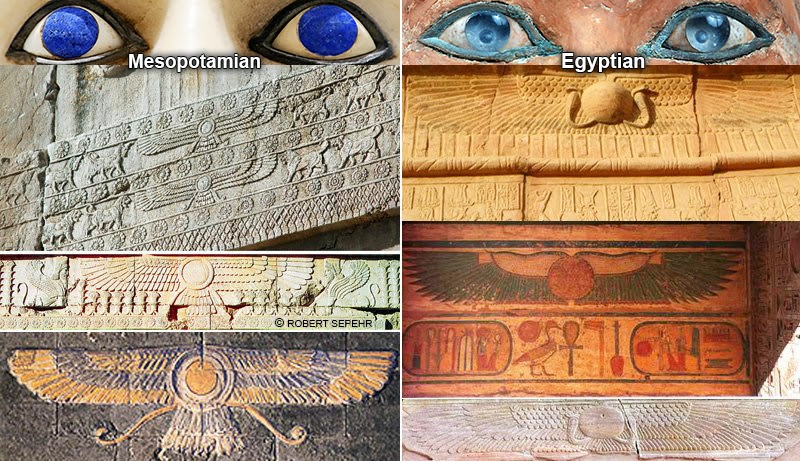
Another one of the oldest documented civilizations, credited with having the first writing, schools, courts, and many other "firsts" were the ancient Sumerians of Mesopotamia. The ancient Sumerians thought that blue eyes were a sign of the gods. The Sumerian nobility were blue eyed and fair haired, as most of their busts show.
These blue eyed statues (pictured below) are of Sumerians from the early/mid 3rd millennium BC. ''...they (the Sumerians) certainly belong to the same racial division of mankind as the nations of Europe, they are scions of the Caucasian stock’’ - Arthur Keith (quoted in Ur Excavations, 1927)
Gautama Buddha's physical body is traditionally regarded as having the "Thirty-two Characteristics of a Great Man". These 32 characteristics are described throughout the Pali Canon, and are also regarded as being present in Cakravartin kings as well. #29 on this ancient list is "Eyes deep blue".
Two thousand years ago a mysterious and little known civilization, with a blue-eyed elite, ruled the northern coast of Peru. Its people were called the Moche. They built huge pyramids that still dominate the surrounding countryside; some well over a hundred feet tall.
Archeologists working at Peru's Huaca Pucllana ruins recently pulled a blue-eyed mummy from an ancient tomb thought to be from the ancient Wari culture that flourished before the Incas. Piercing blue eyes undimmed by the passing of 1,300 years, this is the "Lady of the Mask" – a mummy with striking blue eyes, whose discovery could reveal the secrets of a lost culture at the Huaca Pucllana Pyramid located in Lima, Peru. It is the first time a tomb from the region’s Wari culture has been discovered intact and gives historians the chance to learn about the ancient pre-Incan civilizations.
The Lord of Sipán's tomb (pictured below) is held by some archaeologists to be one of the most important archaeological discoveries in this region of the world in the last 30 years, as the main tomb was found intact and untouched by thieves.
He was called Viracocha by the Incas, Kukulkan by the Mayas, Quetzalcoatl by the Aztecs, Gucumatz in Central America, Votan in Palenque and Zamna in Izamal. He and in some cases his ‘men’ were described as being tall, bearded, with white skin, and beautiful emerald blue eyes. Fray Juan Torquemada, the Franciscan missioner, who collected traditions about Quetzalcoatl from the natives of Old Mexico, says: “Quetzalcoatl had blonde hair, and wore a black robe sewn with little crosses of red color.” (Image below published by the Secretary of Education, Mexico)
Scientists stress that the genetic variation, as the press release puts it, is "neither a positive nor a negative" trait. That's a bit disingenuous, as the mutation also produces greater instance of blond hair (sexually selected for even today) and fair skin, which confers a survival advantage by stimulating greater production of vitamin D in sun-starved northern European countries near the arctic circle - where blue eyes are still most prevalent.
Ninety-five percent of Europeans in Scandinavian countries have blue eyes. They are also found to have a greater range of hair and skin color. Comparatively, Europe has a wider variety of hair color and skin pigment than is found in any other continent in the world.
These "mutations" are relatively recent as Europe was colonized only a few thousand years ago, say mainstream scientists. Through interbreeding, the brunette with blue eyes (Neanderthal-type) was evidenced about 35,000- 25,000 years ago by invading Cro magnon types from the Atlantic (Tall, RH negative blood type, Solutrean tool kit).
“The question really is, ‘Why did we go from having nobody on Earth (known) with blue eyes 10,000 years ago to having 20 or 40 percent of Europeans having blue eyes now?”
John Hawks of the University of Wisconsin-Madison said. “This gene does something good for people. It makes them have more kids.” In contrast, most mammals on earth share the "normal" form of the gene. The six-letter sequence is exactly the same among mice, horses, cows, rats, dogs, cats, monkeys, chimpanzees and humans with brown eyes. (No word on what gives Siberian huskies and Siamese cats blue eyes.)