Prague is the capital of the Czech Republic, historical capital of Bohemia, and once was the main residence of several Holy Roman Emperors. It was an important city to the Hapsburg Monarchy and its Austro-Hungarian Empire, playing major roles in the Protestant Reformation, the and the Thirty Years' War
The Protestant Reformationhttps://www.youtube.com/watch?v=jGfqhkKaSPk According to early sources such as the Icelandic sagas, the Swedes were a powerful tribe whose kings claimed descendence from the god Freyr. During the Viking Age, they constituted the basis of the subset known as the 'Rus' people, where we get the word Russian from, also associated with Slavic tribes.
The term German, which are composed of many tribes, but one great ethnic group, literally translates to 'Spear man', 'Gar' means spear, as the spear was the most common of weapons in ancient Germanic society and every free man had at least one.
Much of the real Irish, Scottish, and even British history has been lost and is no longer taught, but parts remain in European myths and legend. Long before Stonehenge, or most of the Egyptian pyramids were built, a thriving village existed in Scotland. One day, a farmer on the island of Orkney, found a large stone that didn’t look like it belonged in its environment. When the farmer flipped over the stone, he was shocked at what he discovered underneath, a hidden and lost village that existed over 5,000 years ago. Irish Myth, Legend, and St Patrick's Purgatory
https://www.youtube.com/watch?v=ADC1MjVYveU
Ireland, Tuatha Dé Danann, Scythians, and Phoenicians
https://www.youtube.com/watch?v=BuN5rf0CoI8
An old Irish legend about an ancient Egyptian princess
https://www.youtube.com/watch?v=4DS-ngVWge4
European Pre-History and the Oera Linda Book
https://www.youtube.com/watch?v=UxEOlsPsjfg
Thank you for supporting Atlantean Gardens!
https://www.patreon.com/user?u=5703352Robert Sepehr is an anthropologist and author
http://amazon.com/Robert-Sepehr/e/B00XTAB1YC/
The Viking Age, the period of great Scandinavian expansion from the late 8th to the late 11th century – is normally associated with violent raids and warfare. But in fact, Viking people were highly civilized, and greatly valued the arts – especially storytelling, about ancient myths, heroic legends, folk tales, and family and local histories.
One of the most important works of Old English literature, Beowulf is an epic poem consisting of over 3,000 lines, beautifully written in alliterative verse. Set in Scandinavia, Beowulf was the hero of a northern Germanic tribe, in what is now southern Sweden, who comes to the aid of a Danish king, who came under attack by Grendel, a descendant of the Biblical Cain. After Beowulf slays him with his bare hands, Grendel's mother also launches an attack, but is also defeated with a giant's sword that he found.
Victorious, Beowulf goes home to Sweden, and becomes king of a sect of sea-faring Goths, called Geats. Before the consolidation of Sweden, they were politically independent of the Swedes, and have now disappeared into legend and history. 50 years after becoming a Geatish king, Beowulf finds his realm terrorized by a dragon, who he then defeats, but is mortally wounded in the battle. After his death, his attendants cremate his body and erect a tower in his memory.
The Frisians are a Germanic ethnic group indigenous to the coastal parts of the Netherlands, Scandinavia, and northwestern Germany. The Oera Linda Book is a manuscript written in a form of Old Frisian, purporting to cover historical, mythological, and religious themes of remote antiquity. The text alleges that Europe was for a large part of their history, ruled by a succession of folk-mothers presiding over a hierarchical order of celibate priestesses dedicated to the goddess Freya. Kulning is an ancient Frisian herding call that was used by women long ago to call home the cows and goats back to the farm in the evenings.
Lebus is a small town in eastern Germany, near Frankfort, located on the west bank of the Oder river at the modern border with Poland. In 1850, a mysterious stranger was found wandering around the town, seemingly lost, and speaking a broken form of German. Confronted by authorities, he did not appear to be able to speak or understand any of the European languages, except for his imperfect form of German, and claimed to have come from an unknown country called Laxaria, separated by vast oceans from Europe.
He said his purpose in coming was to seek a long-lost brother; but he suffered shipwreck on the voyage and did not know where the wreck occurred, nor how he arrived in Germany, and he could not trace his route on shore on any map or globe. He said his name was Jophar Vorin, and the historical record of what happened to him ended as inexplicably as it began, but is still used as an example to describe the possibility of parallel universes, alternate realities, or inhabitants from Inner Earth.
Mercury is a god in Roman mythology, the equivalent of Hermes in Greek mythology, Thoth in ancient Egypt, and one of the 12 deities within the ancient Roman pantheon. Mercury is also a shiny, silvery, metal, sometimes called quicksilver, and the only metal that is a liquid at standard room temperature.
The spiritual elite of India have been using and handling alchemically purified and solidified Mercury for thousands of years, and ancient Vedic scriptures describe the use of spinning Mercury to achieve anti-gravitational propulsion for flying craft called Vimanas.
Some have called Doggerland the Stone Age Atlantis of Britain, while others think of it as a sort of prehistoric Garden of Eden. Doggerland was an area of land, now submerged beneath the southern North Sea, that connected Britain to continental Europe. It was flooded by rising sea levels around 8,000 years ago. Scandinavia is a region in Northern Europe, with strong historical, cultural, and linguistic ties. The term Scandinavia in local usage covers the three kingdoms of Denmark, Norway, and Sweden.
The idea that our planet consists of a hollow, or honeycombed, interior is not new. Some of the oldest cultures speak of civilizations inside of vast cavern-cities, within the bowels of the earth. According to certain Buddhist and Hindu traditions, secret tunnels connect Tibet with a subterranean paradise, and they call this legendary underworld Agartha. In India, this underground oasis is best known by its Sanskrit name, Shambhala, thought to mean 'place of tranquility.'
Mythologies throughout the world, from South America to the Arctic, describe numerous entrances to these fabled inner kingdoms. Many occult organizations, esoteric authors, and secret societies concur with these myths and legends of subterranean inhabitants, who are the remnants of antediluvian civilizations, which sought refuge in hollow caverns inside the earth. Where are the entrances to inner earth, and which races live there?
German Navy Grand Admiral Karl Dönitz stated in 1943: "The German submarine fleet is proud of having built for the Führer in another part of the world a Shangri-La, an impregnable fortress." This is why Secretary of Defense James Forrestal sent a naval task force to invade Antarctica, including Admiral Nimitz, Admiral Krusen and Admiral Byrd, called “Operation Highjump”.
Over 4,500 military troops from the U.S., Britain and Australia consisting of three Naval battle armadas departed from 3 separate locations in 1946. Byrd was given unlimited funding and 8 months to complete the operation. The mission did not go as planned. Admiral Byrd suffered massive casualties, his fleet was destroyed, and what remained of his armada retreated in disgrace from a humiliating defeat in just under 2 weeks.
In 1947, the Chilean newspaper "El Mercurio" carried an article from its correspondent Lee van Atta aboard the support ship 'Mount Olympus'. The title of the article was: "Admiral Richard E Byrd refers to the Strategic Importance of the Poles."
English translation of the article:
"Admiral Richard E. Byrd warned today that the United States should adopt measures of protection against the possibility of an invasion of the country by hostile aircraft coming from the polar regions. The Admiral explained that he was not trying to scare anyone, but the cruel reality is that in case of a new war, the United States could be attacked by aircraft flying over one or both poles. This statement was made as part of a recapitulation of his own polar experience, in an exclusive interview with International News Service. Talking about the recently completed expedition, Byrd said that the most important result of his observations and discoveries is the potential effect that they have in relation to the security of the United States. The fantastic speed with which the world is shrinking – recalled the Admiral – is one of the most important lessons learned during his recent Antarctic exploration. I have to warn my compatriots that the time has ended when we were able to take refuge in our isolation and rely on the certainty that the distances, the oceans, and the poles were a guarantee of safety".
Around the turn of the 20th century, the British zoologist Philip Sclater noted the geographic distribution of a particular group of primates - the Lemurs. He provided that Madagascar, with it's rich diversity of species, was the primordial homeland of lemurs which spread all over Asia and Africa by a land bridge once connecting these continents. He named this supposed land bridge, appropriately "Lemuria".
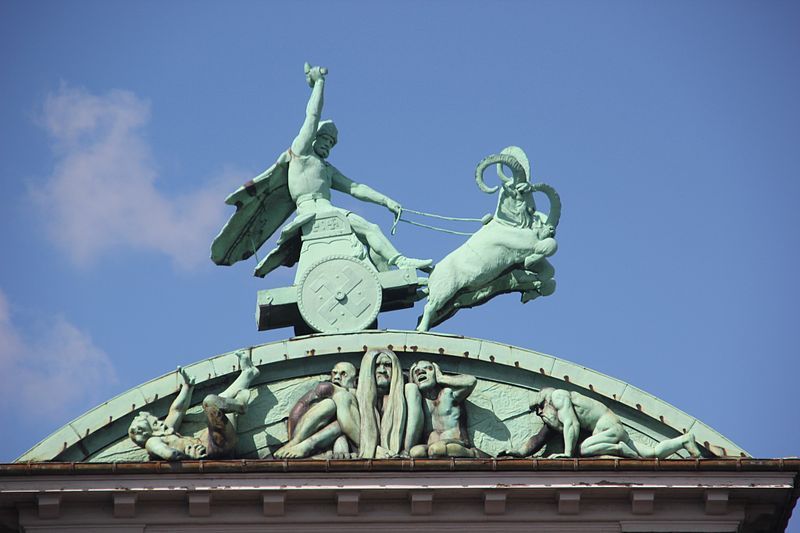
Thor is the Norse god of thunder, the sky, and agriculture. He is the son of Odin, and the defender of Asgard, realm of the gods, and Midgard, the human realm. He developed from the earlier Germanic god Donar and became the most popular deity of the Norse pantheon. The modern English and German words for the fifth day of the week – Thursday and Donnerstag – both allude to Thor/Donar (“Thor’s Day”/“Donar’s Day”).
Robert Sepehr is an author, producer and anthropologist. A harsh critic of the out-of-Africa theory, Sepehr puts forth alternative diffusionist arguments often involving advanced antediluvian civilizations, occult secret societies, ancient mythology, alchemy and astrotheology. http://www.amazon.com/Robert-Sepehr/e/B00XTAB1YC/
In the space of only decades, the continent of Antarctica has lost trillions of tonnes of its ice cover at alarming rates, even in places we once thought were safe. Now, a stunning new void has been revealed amidst this massive vanishing act, and it's a big one: a gigantic cavity growing under West Antarctica that scientists say covers two-thirds the footprint of Manhattan and stands almost 1000 ft tall.
This huge opening at the bottom of the Thwaites Glacier – a mass infamously dubbed the "most dangerous glacier in the world" – is so big it represents an overt chunk of the estimated 252 billion tonnes of ice Antarctica loses every year. Researchers say the cavity would once have been large enough to hold some 14 billion tonnes of ice. Even more disturbing, the researchers say it lost most of this ice volume over the last three years alone.
"We have suspected for years that Thwaites was not tightly attached to the bedrock beneath it," says glaciologist Eric Rignot from the University of California, Irvine, and NASA's Jet Propulsion Laboratory (JPL) in Pasadena, California. Thanks to a new generation of satellites, we can finally see the detail."
Rignot and fellow researchers discovered the cavity using ice-penetrating radar as part of NASA's Operation IceBridge, with additional data supplied by German and French scientists. According to the readings, the hidden void is but one ice casualty among a "complex pattern of retreat and ice melt" that's taking place at Thwaites Glacier, sectors of which are retreating by as much as 2,625 ft every year.
The complex pattern the new readings reveal – which don't fit with current ice sheet or ocean models – suggest scientists have more to learn about how water and ice interact with one another in the frigid but warming Antarctic environment. "We are discovering different mechanisms of retreat," first author of the new paper, JPL radar scientist Pietro Milillo explains.
While researchers are still learning new things about the complex ways ice melts at the Thwaite Glacier, at its most basic, the giant cavity represents a simple (if unfortunate) scientific actuality.
"[The size of] a cavity under a glacier plays an important role in melting," Milillo says. As more heat and water get under the glacier, it melts faster."
That's important to know, since Thwaites currently accounts for about 4 percent of global sea level rise. If it were to disappear entirely, the ice held in the glacier could lift the ocean by an estimated about 2 ft. But that's not even the worst-case scenario. The Thwaites Glacier actually holds in neighboring glaciers and ice masses further inland. If its buttressing force disappeared, the consequences could be unthinkable, which is why it's considered such a pivotal natural structure in the Antarctic landscape.
Just how long it will stay, nobody knows – which is why scientists are right now embarking on a major expedition to learn more about Thwaites. What they'll find remains to be seen, but it's inarguably among the most important scientific research being conducted in the world right now.
Ancient myths from around the world describe numerous entrances to vast underground cavern-cities, within the bowels of the earth. Many occult organizations, esoteric authors, and secret societies concur with these legends of subterranean inhabitants, who are the remnants of antediluvian civilizations, which sought refuge in hollow caverns inside the earth.
A massive network of 12,000 year old underground tunnels discovered that stretch from Scotland to Turkey.
The prehistoric temples of Malta include many subterranean passageways, including ancient catacombs and chambers, with underground tunnels that have now been closed off to the public.
New Swabia (Neuschwabenland) is an area of Antarctica between 20°E and 10°W in Queen Maud Land. It was explored by the German Antarctic Expedition which discovered ice-free areas with warm fresh-water lakes and vegetation. In 1943, German Navy Grand Admiral Karl Dönitz stated: "The German submarine fleet is proud of having built for the Führer in another part of the world a Shangri-La, an impregnable fortress."
While the idea of anti-gravity space flight, or a breakaway German colony on the Moon, or a subterranean UFO base in Antarctica, might all sound like science fiction, what can be said for certain is that they are not new ideas, nor do not seem to be easily explained away.
Robert Sepehr is an author, producer and independent anthropologist.
The Hermann Monument commemorates a Germanic war chief named Arminius who famously led an alliance of Germanic tribes that ambushed and annihilated three Roman legions and their auxiliaries in the Battle of the Teutoburg Forest in 9 AD. In AD 98, the Roman historian Cornelius Tacitus wrote a text called “About the Origin and Mores of the Germanic Peoples,” or Germania, as it came to be called. In the 1940's, the Germania was taught in German schools and widely celebrated as a comprehensive account of the ancient Germanic people. It describes a proud, brave and virtuous people, but The Germans were not one nation — Tacitus lists 50 tribes that were united to defeat Rome.
Robert Sepehr is an author, producer, and independent anthropologist.
Phoenicia was a sea-faring civilization, that included the coastal areas of today's Lebanon, northern Israel, and Southern Syria from about 1550 BC to 300 BC. The Phoenician writing system became widely used, spread by their merchants across the Mediterranean, where its alphabet evolved and was assimilated by many other cultures.
Dabke is a folk dance native to the Eastern Mediterranean, the Palestinian Dabke jumps may have origins in ancient Canaanite fertility rites, where the Phoenicians were probably the first teachers of the dance to the rest of the world. Generally speaking, ancient dances were often connected with religious rituals, a link that was common up to the 16th century and still continues in some countries. Robert Sepehr is an author, producer and independent anthropologist.
The legendary pre-flood civilizations like Atlantis, Thule, and Hyperborea were said to have been built on highly advanced science and technology, with a possibly direct connection with what is happening now around the world. In the pre-Flood world of Noah, it is written that there was cross-species (interracial) breeding going on between the “sons of God,” or the B’nai Elohim and mortal human women. The ancient rabbinic scholars believed that the term “sons of God” specifically referred to fallen angels and this was in fact the teaching of the early church for several hundred years.
The offspring of these fallen angels procreating with human women where called the Nephilim. Much of these stories have been effectively suppressed for centuries and banned from inclusion in later versions of the Bible, but have been recently re-discovered; for example in passages from The Book of Enoch. There are numerous other universal mythologies of pre-Flood legends that speak of these god men coming from the stars, or below the earth, and seeding human civilizations.
One of the forces supposedly used by certain groups in these pre-Flood times was a mysterious life energy, that the Nazis re-discovered, called the Vril force. The Vril force, the energy fields studied by Nicola Tesla, and what is now called scalar technology are based on similar theories deriving from quantum mechanics. The Nazi concept of a Vril force is based on the idea that a race of god men came from the stars in ships powered by this force and settled on the legendary island of Thule where they founded the civilization called Hyperborea.
Robert Sepehr is an author, producer, and independent anthropologist.
Serving as the inspiration for Disneyland's Sleeping Beauty Castle, is the Neuschwanstein Castle (New Swan Stone Castle), originally intended as a personal refuge for Ludwig II of Bavaria, who is sometimes referred to as the Swan King. He also held the titles of Duke of Bavaria, and the Duke of Swabia. Swabia is a region in South Western Germany, representing the territory of Alemannia, which coincides with the Swabian Circle of the Holy Roman Empire, as it stood during the Early Modern period, now near south western Bavaria. Lohengrin is a character in German Arthurian literature, a knight of the Holy Grail sent in a boat pulled by swans to rescue a maiden who can never ask his identity.
New Swabia (Neuschwabenland) is an area of Antarctica between 20°E and 10°W in Queen Maud Land. It was explored by the German Antarctic Expedition which discovered ice-free areas with warm fresh-water lakes and vegetation. In 1943, German Navy Grand Admiral Karl Dönitz stated: "The German submarine fleet is proud of having built for the Führer in another part of the world a Shangri-La on land, an impregnable fortress."
While it is widely accepted that the Nazis were defeated with the German Government's formal surrender in 1945, this is only partly true. The media is largely controlled by the Rothschild banking dynasty, and has promoted a false narrative concerning the events of WW2.
Hitler's body was never recovered, and no Nazi party member ever signed any documents of surrender. That is why, after the Allies claimed unconditional victory, Secretary of Defense James Forrestal sent a naval task force, called “Operation Highjump,” to Antarctica, including Admiral Nimitz, Admiral Krusen and Admiral Byrd. Over 4,700 military troops from the U.S., Britain and Australia, consisting of three Naval battle groups departed on December 2, 1946.
The US military and intelligence were apparently trying to locate the immense underground facility constructed by the Germans, before, during and immediately after the Second World War (Section-211). The base was likely used to further their research and successful development of advanced propulsion technology, based on free energy.
According to first hand testimonials from crew members participating in Operation Highjump, including an interview given by Admiral Byrd himself, the Antarctic Nazis developed their saucer-shaped discs far in advance of anything possessed by the U.S. They swiftly defeated the massive "post WW2" Allied military attack.
Top Secret maps obtained by the KGB and belonging to the Third Reich have been leaked on the internet which allegedly depict passages under the Antarctic ice used by German U-Boats to access underground polar caverns.
The possibility that the earth contains massive subterranean caverns, or is at least partially hollow, that these regions are accessible through passages at the poles, and that ancient secret breakaway civilizations flourish within them, has renewed people's interest in a subject still considered by the media to be taboo. Could the Earth really have entire inhabited cities underground that we are unaware of on the surface? Where are the entrances to inner earth, and which races live on the inside?
The idea that our planet consists of a hollow, or honeycombed, interior is not new. Some of the oldest cultures speak of civilizations inside of vast cavern-cities, within the bowels of the earth. According to certain Buddhist and Hindu traditions, secret tunnels connect Tibet with a subterranean paradise, and they call this legendary underworld Agartha. In India, this underground oasis is best known by its Sanskrit name, Shambhala, thought to mean 'place of tranquility.' Mythologies throughout the world, from South America to the Arctic, describe numerous entrances to these fabled inner kingdoms. Many occult organizations, esoteric authors, and secret societies concur with these myths and legends of subterranean inhabitants, who are the remnants of antediluvian civilizations, which sought refuge in hollow caverns inside the earth.
Assuming that the myths are true, and the Earth is partially hollow, how could life survive underground? How would organisms receive the ventilation required to breathe miles below the surface? What would provide the light needed to see, or to cause the photosynthesis necessary for the plant life that allegedly exists in these inner worlds? Are there any known sources of sustenance available that could provide for a large human population?
Author and anthropologist, Robert Sepehr, explores these questions and attempts to unlock their riddles, which have eluded any serious consideration in mainstream academia. Numerous endevours have been undertaken to access the interior of the earth. Polar expeditions and battles, such as Operation Highjump, still remain largely classified, and have been shrouded in secrecy for decades, but scientific revelations validating the rumors surrounding these covert events, and their implications, are finally being exposed to daylight. What are the mysteries of inner Earth?