The Achaemenid, or the First Persian Empire, was founded by Cyrus the Great in 550 BC, and extended from Eastern Europe in the west to the Indus valley. It was larger than any previous known empire in history, building road systems, postal systems, and showing its citizens a lot of religious tolerance.
In Iran, located on Mount Behistun, which means 'place where the gods dwell', four similar tombs are cut into the stone cliffs, as well as an inscription by Darius the Great, which was crucial to the decipherment of cuneiform script, as the inscription includes three versions of the same text, written in three different cuneiform script languages: Elamite, Babylonian, and Old Persian. The inscription is to cuneiform, what the Rosetta Stone is to Egyptian hieroglyphs: the document most crucial in the decipherment of a previously lost script.
Samodivas are woodland fairies found in South and West Slavic folklore and mythology, commonly depicted as ethereal maidens with long hair, and in some cases, wings. In Macedonian folklore, they were said to inhabit oak or willow trees, and in Romanian mythology they are known as Iele, with great seductive power over men, and magic skills and attributes similar to nymphs found in Greek mythology, sometimes reported to have been seen bathing in the springs or at crossroads.
In classical antiquity, Illyria was a region in the western part of the Balkan Peninsula inhabited by numerous tribes of people collectively known as the Illyrians. Besides them, this region was also settled, in various times, by some tribes of Celts, Goths and Thracians.
The Thracians were a group of Indo-European or Aryan tribes inhabiting a large area in Eastern and Southeastern Europe. They spoke the Thracian language – part of the Indo-European language family, and in the Iliad are described as allies of the Trojans in the Trojan War against the Ancient Greeks.
There were about 200 Thracian tribes, with A strong Dacian state appeared in the first century BC, Including the Illyrians, who inhabited part of the western Balkans, which came to be known as Illyria to Greek and Roman authors, who identified a territory that corresponds to Croatia, Bosnia and Herzegovina, Slovenia, Montenegro, Kosovo, part of Serbia and most of central and northern Albania.
The Varna culture belongs to the later Neolithic of northeastern Bulgaria, dated ca. 4400-4100 BC. The Balkans, also known as the Balkan Peninsula, is a geographic area in southeastern Europe.
The Goths were a Germanic people that played an important role in the fall of Rome through the long series of Gothic Wars and in the emergence of Medieval Europe. They dominated a vast area, which at its peak possibly extended all the way from the Danube to the Don, and from the Baltic Sea to the Black Sea. They spoke the Gothic language, one of the extinct East Germanic languages. The Visi-goths were the western branches of the Germanic tribes referred to collectively as the Goths, and Alaric was the first King of the Visigoths, best known for his sack of Rome in 410. Notre-Dame de Paris ("Our Lady of Paris") is consecrated to the Virgin Mary and considered to be one of the finest examples of French Gothic architecture. It was recently burned in a fire.
Tuatha Dé Danann means tribe of the goddess Danu, a god-like mythological race from pre-Christian Gaelic Ireland, descended from Nemed, leader of a previous wave of Irish inhabitants. Nemed was the son of Agnoman of Scythia, who was descended and the Scythians have been associated with the Tribe of Dan. The Scythians, also known as Scyth, Saka, Sakae, Sai, Iskuzai, or Askuzai. In the 18th century, linguists noticed the great similarity between that Phoenician and the early Irish Celtic language.
Ireland's long history is riddled with folklore, ancient mythology, and ancient societies, such as the Druids. Scota, in Irish legend, is the name given to the daughter of an Egyptian Pharaoh. An old Irish legend about an ancient Egyptian princess:
The various royal houses of English history: the Saxons, Danes, Normans, Tudors, Stuarts, Plantagenets, Hanoverians, Saxe-Coburgs, all lines blended and fused with Scottish royalty to form the modern House of Windsor, trace their bloodlines back to a common migration. The Encyclopedia Americana records the Scythians arrived in the region of South Russia “about 700 B.C.”
Herodotus wrote: “They [the Scythians] make no offerings of pigs, nor will they keep them in their country.” Since the Scythians not only refused to allow pigs to be used in sacrificial purposes, but also banned them entirely from their territory, it is evident that the Scythians did not eat the flesh of swine either.
Robert Sepehr is an author, producer and anthropologist.
The Hittites established an empire centered on Hattusa in north-central Anatolia around 1600 BC. In the Amarna tablets, which have been dated to the 14th century BC, the Hittites were clearly regarded by the Egyptians as a major power. In antiquity, the swastika (卐) was used extensively by the Hittites, sometimes as a geometrical motif, other times as a religious symbol.
Robert Sepehr is an author, producer, and anthropologist.
American congressman Ignatius Loyola Donnelly (1831-1901) wrote a chapter titled "The Aryan Colonies From Atlantis" in his book, Atlantis: The Antediluvian World, where he said:
Did the Aryan race come from Atlantis?
"The center of the Aryan migrations was Armenia. Here too is Mount Ararat, where it is said the ark rested, another identification with the Flood regions, as it represents the usual transfer of the Atlantis legend by an Atlantean people to a high mountain in their new home."
"The Greeks, who are Aryans, traced their descent from the people who were destroyed by the Flood, as did other races clearly Aryan, herein we find another evidence of relationship between the Aryans and the people of Atlantis.. the Greeks, an Aryan race, in their mythological traditions, show the closest relationship to Atlantis. We have seen that Zeus, the king of Atlantis, whose tomb was shown at Crete, was transformed into the Greek god Zeus."
"There is another reason for supposing that the Aryan nations came from Atlantis. We find all Europe occupied by nations recognized as Aryan."
- Ignatius Donnelly, Atlantis: The Antediluvian World, 1882
The Bronze Age is a historical period characterized by the use of bronze, and in some areas proto-writing, and other early features of urban civilization. Aryan is a term that was used as a self-designation by Indo-Iranian people, for example, etched in stone in the Behistun Inscription, a multilingual inscription and large rock relief on a cliff from 522BC at Mount Behistun in modern Iran telling the story of King Darius' conquests.
Phoenicia was an ancient Mediterranean sea-faring civilization that originated in the Levant in the west of the Fertile Crescent. The Silk Road was an ancient network of trade routes that connected the East and West.
To the Germans he was known as Votan. To the Anglo-Saxons Woden. To the Norse and other Scandinavians, he was known as Odin. A Reuters News Agency report from Nov. 30, 2001: "The Viking god Odin may have been a real king who lived in what is now southern Russia 2,000 years ago, according to Norwegian explorer Thor Heyerdahl.
In The Hunt for Odin, Heyerdahl says his archaeological digs by the Sea of Azov in Russia backed evidence in 13th century sagas written by Snorre Sturlason that Odin was more than a myth. Odin was a king who lived around Azov before being driven out by the Romans and taking his followers to Sweden.
Ancient metal belt holders, rings and armbands dating from 100-200 AD found in excavations around the mouth of the Don River were almost identical to Viking equivalents found in Gotland, Sweden, some 800 years later, he said.
The various royal houses of English history: the Saxons, Danes, Normans, Tudors, Stuarts, Plantagenets, Hanoverians, Saxe-Coburgs, all lines blended and fused with Scottish royalty to form the modern House of Windsor, trace their bloodlines back to a common migration. The Encyclopedia Americana records the Scythians arrived in the region of South Russia “about 700 B.C.”
Herodotus wrote: “They [the Scythians] make no offerings of pigs, nor will they keep them in their country.” Since the Scythians not only refused to allow pigs to be used in sacrificial purposes, but also banned them entirely from their territory, it is evident that the Scythians did not eat the flesh of swine either.
The Hermann Monument commemorates a Germanic war chief named Arminius who famously led an alliance of Germanic tribes that ambushed and annihilated three Roman legions and their auxiliaries in the Battle of the Teutoburg Forest in 9 AD. In AD 98, the Roman historian Cornelius Tacitus wrote a text called “About the Origin and Mores of the Germanic Peoples,” or Germania, as it came to be called. In the 1940's, the Germania was taught in German schools and widely celebrated as a comprehensive account of the ancient Germanic people. It describes a proud, brave and virtuous people, but The Germans were not one nation — Tacitus lists 50 tribes that were united to defeat Rome.
Robert Sepehr is an author, producer, and independent anthropologist.
Archaeologists in Kazakhstan have recreated the impressive attire of an ancient Scythian princess from fragments discovered in a treasure-filled burial discovered two years ago in the Terekty district of Western Kazakhstan.
They have also placed on display the unique golden artifacts found in the grave of the princess, who has been dubbed ‘Golden Woman’. Dating back 2,500 years, it is the oldest golden burial to have been unearthed in the country.
The 'Golden Woman' was found buried in a mound, known as a kurgan, alongside numerous gold and silver vessels, makeup kits, golden jewelry, a headdress, a horse bridle, and other household items that were considered essential for the afterlife.
The features of her burial are characteristic of Zoroastrianism, an ancient Iranian religion and Aryan philosophy, which spread eastward towards Kazakhstan. The princess belonged to the Saka (ancient Scythians), a group of nomadic warrior tribes of Aryan/Iranian origin, who inhabited the steppes of modern-day Kazakhstan from around 1,000 BC to the first century AD.
In total, more than 500 different golden fragments were found in her burial, which earned the woman her name - the Golden Woman or the Golden Princess. Reconstruction of the garment was entrusted to the famous restorer Krym Altynbekov. Thanks to his work, one can now see what Golden Princess might have looked like 2500 years ago.
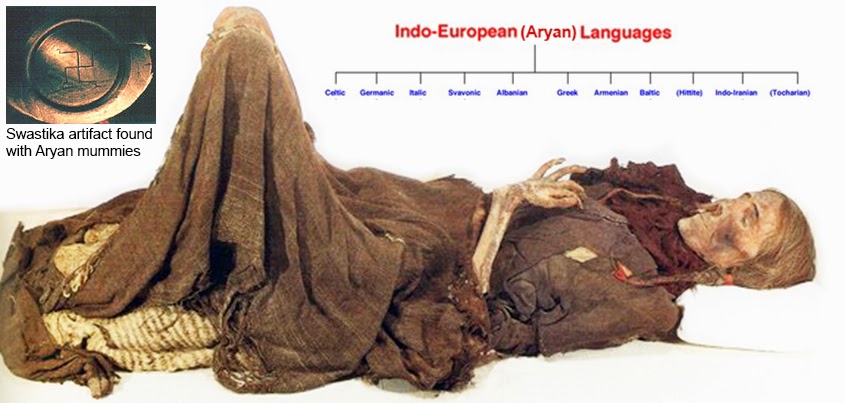
She was covered with a blanket embroidered with golden plaques of four types: differently shaped geometric pieces depicted ram griffins, rams, griffins and swastikas. Scientists call them solar, implying worship of the sun characteristic for the nomads of the time, which is also supported by the "Avesta", the core collection of sacred Zoroastrianism texts.
Swastika-shaped plaques depicting four griffin heads arranged in a circular composition.
One artifact that was of particular importance was a wooden comb depicting a battle scene in the war of the Saks against the Persians. The composition shows two soldiers in a chariot and their enemy, a single foot soldier, inscribed in the rectangular space in the center of the crest/comb.
Reconstruction of the comb by Krym Altynbekov
“The Golden Woman/Princess is one of the most astonishing archaeological findings of the recent years,” reports Tengri News. “It sheds some light on the wealth and power of the ancient Scythians.”
LEFT: The pommel of the headdress. RIGHT: Golden bracelets.
In his 1896 book, The Swastika: The Earliest Known Symbol and its Migrations, Thomas Wilson, former curator of the Department of Prehistoric Anthropology in the U.S. National Museum, wrote of the swastika: “An Aryan symbol (卐) used by the Aryan peoples before their dispersion through Asia and Europe. This is a fair subject for inquiry and might serve as an explanation how…as a sacred symbol…the Swastika might have been carried to the different peoples and countries in which we now find it by the splitting up of the Aryan peoples and their migrations and establishment in the various parts of Europe.”
New genetic, archeological, and linguistic research has demonstrated that the supposedly "discredited" Aryan Race Theory may have been right after all. This theory argued that fair-haired, light-eyedNordic agriculturalists, having tamed the horse and invented the wheel, conquered most of Europe, much of the Middle East and Northern India thousands of years ago, bringing with them the family of languages that used to be known as Aryan, and are now known as Indo-European, spoken from Ireland to India.
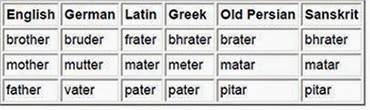
The Indo-European family of languages includes Modern English, German, French, Italian, Irish, Greek, Russian and indeed all European languages apart from Finnish, Hungarian and Basque, together with Iranian, Pashtu, Hindi, Gujarati, Bengali. Sinhalese and other Northern (or originally Northern) Indian languages. The kinship can still be seen in basic words like one, two, three--amhain, dha, tri in Irish, une, deux, trois in French, unus, duo, tres in Latin, eins, zwei, drei in German, einn, tver, thrir in Icelandic, odin, dva, tri in Russian, ena, duo, tria in Greek.
In the ancestor of the Indian branch of this language family, Sanskrit, it's eka, dva, treya. The people who spoke that language swept into the plains of Northern India almost 4,000 years ago as chariot-riding conquerors, calling themselves Aryas, "lords." On the way they gave their name to Iran, derived from "Aryan."
Others swept eastward, where for a thousand years an Indo-European language, Tocharian, was spoken in what is now Chinese Turkestan. Suggestion that this ancient race of more-advanced conquerors were blonde-haired, blue-eyed Nordics were dismissed since 1945 as "discredited"--i.e., Politically Incorrect rather than proved wrong. Linking race and culture was a big academic career-ending no-no.
But meanwhile archaeologists and historians of languages, avoding such explosive topics, managed to link the Proto-Indo-Europeans, the conquerors before they exploded from their homeland, to the Bronze Age Androvonovo Culture, based in western Siberia and what is now Kazakhstan.
The remains of the people themselves were buried in great mounds, like later Viking and Anglo-Saxon barrows and howes, known as kurgans. These are similar to the ancient native American mounds found scattered all over the Mississippi valley.
Now geneticists have examined the DNA of these Proto-Indo-Europeans, or Aryans as they probably called themselves and were called until the PC shutters came down, extracted from their ancient tombs.
The results are deeply Politically Incorrect, as revealed in three seminal papers:
C. Bouakaze et al, First successful assay of Y-SNP typing by SNaPshot
minisequencing on ancient DNA, International Journal of Legal Medicine,
vol 121 (2007), pp. 493-499.
C. Keyser et al, Ancient DNA provides new insights into the history of South
Siberian Kurgan people, Human Genetics, vol. 125, no. 3 (September 2009),
pp. 395-410.
It turns out that genetically the Proto-Indo-Europeans buried in the steppe kurgan graves 5,000 years ago were identical with modern Western and Northern Europeans belonging to the Nordic sub-race. The majority had light hair and blue and green eyes. It wasn't until much later that the gene complexes associated with other racial
types appeared in the Central Asian steppe north of the deserts and irrigated
farming zone.
The typical steppe nomad horseman before the Turks and later the Mongols spread
west, and the typical Aryan who brought what is now Hinduism to India and gave
his speech to almost every nation from the Bay of Bengal to the Atlantic looked,
it is now clear from the genetic evidence, like a modern northern European.
And indeed
do the mummified remains of the Tocharian speakers in what is now Chinese
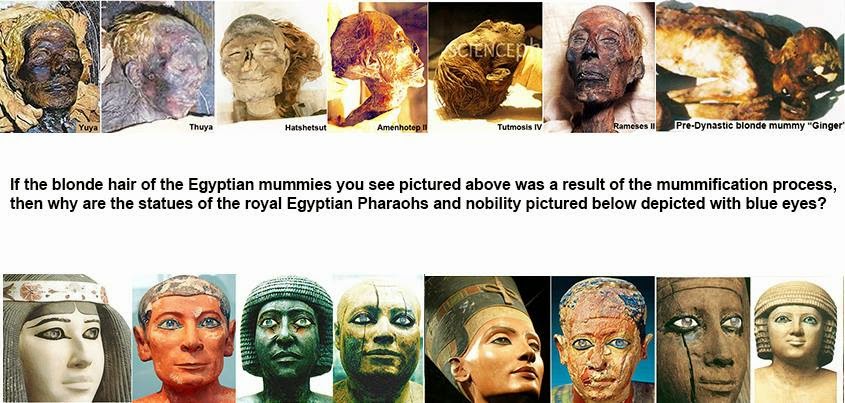
Turkestan, who have blonde and red hair. So, incidentally, did many early Pharaohs of Egypt.
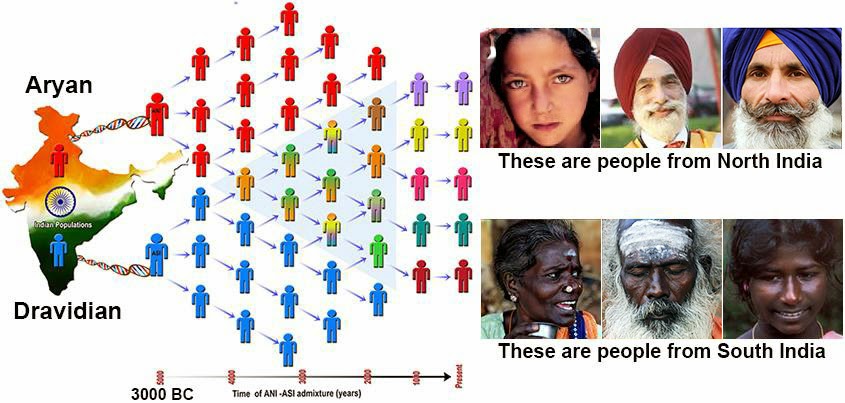
It is also clear from the appearance of most speakers
of Indo-Aryan languages today in Pakistan, Northern India, Blackburn, Leicester
and a corner shop near you, that significant interbreeding has occurred between
conquerors and conquered in the 4,000 years since.