970 x 90

Saturday, April 9, 2016

Mammoth Cave rumored to lead to Inner Earth - ROBERT SEPEHR


Located in central Kentucky and covering well over 52,000 acres, the Mammoth Cave was established as a national park in 1941, and as a World Heritage Site in 1981. With a staggering 400 miles (640 km) of surveyed passageways, Mammoth Cave is by far the world's longest known cave system, over twice as long as the second-longest cave system, Mexico's Sac Actun underwater cave. Archeologists are constantly making new discoveries and additional connections in this cave system, adding several miles to this figure each year.

The Echo River Tour, one of the cave's most famous attractions, took visitors on a boat ride along an underground river, but the tour was discontinued in the early 1990s. There are rumors of deep passageways not accessible to tourists.

H.P. Lovecraft's short story, The Beast in the Cave, is set in Mammoth Cave. He finished the final draft in 1905, when he was fourteen, and published it in the June 1918 issue of the amateur press journal, The Vagrant.

The plot involves a man on a tour of Mammoth Cave who separates from his guide and becomes lost. His torch finally expires, leaving him hopeless of finding a way out in the pitch dark. He then hears strange sounding footsteps approaching. Thinking it a lost mountain lion, he desperately throws a stone at the source of the sound. The beast is hit and crumples to the floor.


The guide eventually finds the protagonist, and together they examine the fallen creature with the guide's torchlight. As the creature mutters its last breaths, revealing its face, they discover that it is a pale, deformed human, who actually had lived in the caves for years.

Several sets of Native American remains have been recovered from Mammoth Cave. Many of these mummified remains indicate intentional pre-Columbian funerary practice. Another fascinating discovery was the remains of cane torches used by Native Americans. Could there have been civilizations that took rfuge deep inside these massive caverns? What are the mysteries involving subterranean passages to inner earth?

Author and anthropologist, Robert Sepehr, explores these questions and attempts to unlock their riddles, which have eluded any serious consideration in mainstream academia.
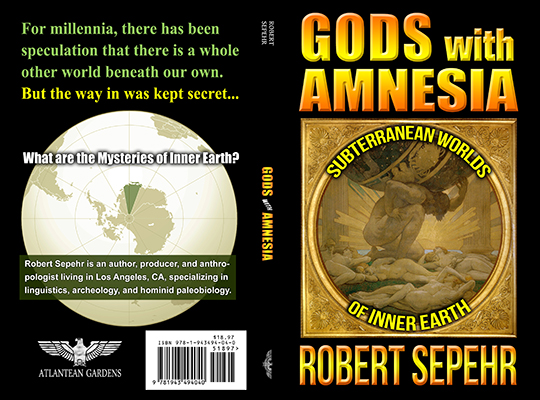
Gods with Amnesia


Friday, April 8, 2016

Massive Subterranean Caves of China - ROBERT SEPEHR

Inner earth china

Reed Flute Cave, known as the “Palace of Natural Arts,” is located in southern China. According to a legend, Reed Flute Cave got its name because the reeds by the cave’s mouth could be made into flutes. The limestone cave offers a majestic fairyland of stalactites, stalagmites, stone pillars, birds, and plants in fantastic shapes and colors.

Inside, there are more than 70 inscriptions in ink, which date back as far as 792 AD in the Tang Dynasty. These aged inscriptions tell us that it has been an attraction in Guilin since ancient times. The cave is about 240 meters long and a tour currently lasts about one hour.

The interior of the cave is a veritable show gallery of gorgeous geological formations, created by thousands of years of water erosion on the soft limestone. The walls also consist of beautifully rippling, eroded patterns which have dripped into the rock over millennia. Today, countless multi-colored lights dramatically illuminate the Reed Flute Cave.

The lights are hidden in the cracks and crevices of the space, and the effect is almost surreal, as the lights turn the otherwise dark space into a strange mix of bright neon colors and rough natural shades.

Inner earth

The idea that our planet consists of a hollow, or honeycombed, interior is not new. Some of the oldest cultures speak of civilizations inside of vast cavern-cities, within the bowels of the earth. According to certain Buddhist and Hindu traditions, secret tunnels connect Tibet with a subterranean paradise, and they call this legendary underworld Agartha.

In India, this underground oasis is best known by its Sanskrit name, Shambhala, thought to mean 'place of tranquility.'

Mythologies throughout the world, from South America to the Arctic, describe numerous entrances to these fabled inner kingdoms. Many occult organizations, esoteric authors, and secret societies concur with these myths and legends of subterranean inhabitants, who are the remnants of antediluvian civilizations, which sought refuge in hollow caverns inside the earth.

Assuming that the myths are true, and the Earth is partially hollow, how could life survive underground?

How would organisms receive the ventilation required to breathe miles below the surface? What would provide the light needed to see, or to cause the photosynthesis necessary for the plant life that allegedly exists in these inner worlds? Are there any known sources of sustenance available that could provide for a large human population? Where are the entrances to inner earth, and which races live on the inside?

China

Author and anthropologist, Robert Sepehr, explores these questions and attempts to unlock their riddles, which have eluded any serious consideration in mainstream academia. What are the mysteries of inner Earth?

Gods with Amnesia

Mysterious Inner Earth Caves of Slovenia - ROBERT SEPEHR


Gods with Amnesia

The Skocjan cave system in Slovenia includes the highest cave hall in Europe, featuring a massive underground gorge with a waterfall, and a bridge over the gorge that looks like something out of the movie, The Lord of the Rings. The caves have beautiful stalactite and stalagmite structures, which resemble melted wax.

The Skocjan Caves were formed by the sinking Reka River. The river remains on the surface at the cave entrance, but suddenly disappears underground, where it continues its way through the underground caverns. The river emerges on the surface again, not far from the Adriatic coast, after flowing underground for about 21 miles.

Entered on UNESCO’s list of natural and cultural world heritage sites in 1986, the Skocjan Caves represent the most significant under-ground phenomena in both the Karst region and Slovenia, and one of the largest underground canyons in the world. A special ecosystem has developed in these caves due to particular micro-climatic conditions.

The idea that our planet consists of a hollow, or honeycombed, interior is not new. Some of the oldest cultures speak of civilizations inside of vast cavern-cities, within the bowels of the earth. Many occult organizations, esoteric authors, and secret societies concur with these myths and legends of subterranean inhabitants, who are the remnants of antediluvian civilizations, which sought refuge in hollow caverns inside the earth.

Inner Earth

Assuming that the myths are true, and the Earth is partially hollow, how could life survive underground? Where are the entrances to inner earth, and which races live on the inside? Author and anthropologist, Robert Sepehr, explores these questions and attempts to unlock their riddles, which have eluded any serious consideration in mainstream academia.

Inner Earth

Robert Sepehr is an author, producer, and anthropologist specializing in linguistics, archeology, and paleobiology. A harsh critic of the out-of-Africa theory, Sepehr puts forth alternative diffusionist arguments often involving advanced antediluvian civilizations, occult secret societies, ancient mythology, alchemy and astrotheology.

Gods with Amnesia