For many years, the world has hummed a sweet, optimistic tune, about the benefits of globalization, with the mainstream media constantly touting the advantages of an increasingly inter-connected world, with little appreciation for its uneven benefits.
Yuri Bezmenov was a Soviet journalist and a former KGB informant who defected to the West. After being assigned to a station in India, Bezmenov eventually grew to resent the KGB-sanctioned oppression of intellectuals who dissented from Moscow's Marxist policies. He is best remembered for his anti-Communist lectures and books from the 1980s, which when looking back at this interview, has played out just as he described right before our eyes.
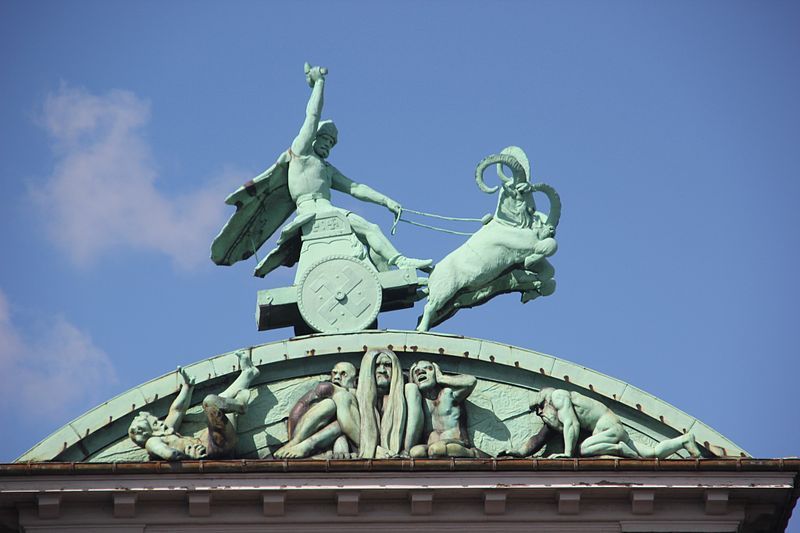
Thor is the Norse god of thunder, the sky, and agriculture. He is the son of Odin, and the defender of Asgard, realm of the gods, and Midgard, the human realm. He developed from the earlier Germanic god Donar and became the most popular deity of the Norse pantheon. The modern English and German words for the fifth day of the week – Thursday and Donnerstag – both allude to Thor/Donar (“Thor’s Day”/“Donar’s Day”).
Robert Sepehr is an author, producer and anthropologist. A harsh critic of the out-of-Africa theory, Sepehr puts forth alternative diffusionist arguments often involving advanced antediluvian civilizations, occult secret societies, ancient mythology, alchemy and astrotheology. http://www.amazon.com/Robert-Sepehr/e/B00XTAB1YC/
Hollywood is a kind of city-state of its own, with its own religion. A druid was a priest, magician, or soothsayer in the ancient Celtic religion that uses a wand made of wood from the Holly tree, or Holly wood. The earliest known records of the Druids come from the 3rd century BC. Relatively early German histories also assume that Druids were to be found among them. The Druids of antiquity are steeped in legend and folklore, having no known written record of where they originally came from.
Propaganda is biased information, especially of a misleading nature, that is used primarily to influence an audience and further an agenda, often to promote or publicize a particular political cause or point of view.
Tuatha Dé Danann means tribe of the goddess Danu, a god-like mythological race from pre-Christian Gaelic Ireland, descended from Nemed, leader of a previous wave of Irish inhabitants. Nemed was the son of Agnoman of Scythia, who was descended and the Scythians have been associated with the Tribe of Dan. The Scythians, also known as Scyth, Saka, Sakae, Sai, Iskuzai, or Askuzai. In the 18th century, linguists noticed the great similarity between that Phoenician and the early Irish Celtic language.
Ireland's long history is riddled with folklore, ancient mythology, and ancient societies, such as the Druids. Scota, in Irish legend, is the name given to the daughter of an Egyptian Pharaoh. An old Irish legend about an ancient Egyptian princess:
The various royal houses of English history: the Saxons, Danes, Normans, Tudors, Stuarts, Plantagenets, Hanoverians, Saxe-Coburgs, all lines blended and fused with Scottish royalty to form the modern House of Windsor, trace their bloodlines back to a common migration. The Encyclopedia Americana records the Scythians arrived in the region of South Russia “about 700 B.C.”
Herodotus wrote: “They [the Scythians] make no offerings of pigs, nor will they keep them in their country.” Since the Scythians not only refused to allow pigs to be used in sacrificial purposes, but also banned them entirely from their territory, it is evident that the Scythians did not eat the flesh of swine either.
Robert Sepehr is an author, producer and anthropologist.
The Sudan is a country in Northeast Africa, bordered by Egypt to the North, Ethiopia to the East, Chad to the West, and Libya to the Northwest, housing 37 million people, making it the third largest nation in Africa. The history of Sudan goes back to the time of the Pharaohs, and includes the rise of the kingdom of Kush.
Holland is a region and former province on the western coast of the Netherlands... a European country, bordering Germany to the East, and Belgium to the South, With a population numbering over 17 million, blessed with one of the most beautiful capital cities in the world, Amsterdam. The Netherlands is a constitutional monarchy, which was divided into 12 provinces, a number that is no coincidence.
It grew to become one of the major economic and sea-faring powers in the world during the 17th century, which is known as the Dutch Golden Age, when many colonies were founded, including the Netherlands East Indies (currently called Indonesia) and New Amsterdam, which was later traded with the British and re-named as New York.
The Dutch East India Company established its first outpost at Cape Town, South Africa, in 1652. Afrikaans is a West Germanic language spoken in South Africa, Namibia and, to a lesser extent, Botswana and Zimbabwe.
Robert Sepehr is an author, producer, and independent anthropologist.
Located in Mali West Africa, the Dogon have a rich culture dating to around 3200 BCE, and are believed to be a hybrid ethnic group descended from a mixing of the ancient Egyptians of North Africa with various other sub-Saharan tribal populations.
Deeply rooted traditions of the Dogon people speak of the Nommos who visited from a companion star to Sirius. The Nommos are known as advanced beings who have also appeared in numerous related myths found in the Sumerian and other Mesopotamian cultures.
Sirius' companion star has a 50 year elliptical orbit and is not visible to the naked eye. According to some research, modern astronomers did not know the companion star existed until the Dogon myth was discovered. They tell us how the Nommos shared the knowledge of Sirius with them and left behind several artifacts. One artifact depicting the Sirius constellation carbon dates to 400 years ago, a little over 230 years before astronomers suspected the existence of the companion star.
The Dogon people were first documented over a several year study performed by anthropologist Marcel Griaule. In his research notes we find conversations between Griaule and a Dogon elder named Ogotemmeli, who speaks of multiple companion stars in the Sirius system.
There are entries suggesting the Nommos visited on a very large star ship on several occasions, and the notes also indicate Dogon people knew of Saturn's rings, and the many moons of Jupiter.
Every 60 years Dogon people celebrate the cycle of Sirius A and B which rises further questions considering Sirius B's 50 year cycle.
Dogon mysteries mention another star in the system, which would be called Sirius C if confirmed by modern telescopes. Nommos are believed to inhabit a planet orbiting Sirius C though mainstream science does not consider the Sirius constellation to be a prime candidate for life.
Credo Mutwa, the 94-year-old Zulu shaman or "sanusi" in South Africa, claims that this picture he had painted of tall, blond-haired, blue-eyed beings had been seen by black African tribes people throughout that continent long before the white Europeans arrived. Credo, the official historian of the Zulu nation, said that when the Europeans first came, the black Africans thought they were the return of these same white "gods", which they called the Mzungu (see his paintings below). As a result they called the European settlers by the same name, which is still used today.
This was very much the same reaction as the Central American peoples when Cortes and his Spanish invasion party arrived in 1519 and they thought that he was the returning god, Quetzalcoatl, another god described as tall, bearded, and with piercing blue eyes.
The Feathered Serpent God appears in many ancient cultures and Mesoamerican legends. He was called Viracocha by the Incas, Kukulkan by the Mayas, Quetzalcoatl by the Aztecs, Gucumatz in Central America, Votan in Palenque and Zamna in Izamal. He and his ‘men’ were usually described as being bearded with white skin, and deep blue eyes.